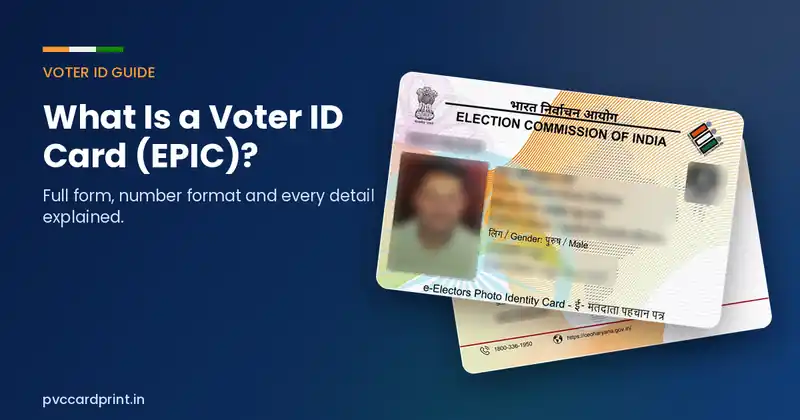
Quick answer: EPIC stands for Electors Photo Identity Card, the photo ID issued free by the Election Commission of India to registered voters. It carries a 10-character EPIC number (usually 3 letters + 7 digits), your photo, details, and a QR code. A digital version, the e-EPIC, can be downloaded as a PDF.
The Voter ID card is one of the most commonly carried identity documents in India. Most people only look at it when an election is near, so questions pile up later: What does EPIC mean? Why are there two cards, one paper and one digital? What is the number printed on it? This guide answers those questions using information published by the Election Commission of India (ECI), and explains where a printed PVC copy fits in.
What does EPIC stand for?
EPIC stands for Electors Photo Identity Card. It is the official photo identity card issued by the Election Commission of India to registered voters. People also call it a voter card, voter ID, election card or voter identity card. All of these usually refer to the same document.
The card was brought into wide use in the early 1990s as a way to reduce impersonation at polling stations. Since then, it has also become a widely recognised proof of identity for everyday paperwork such as bank KYC, SIM verification or travel check-ins, even though its legal purpose is electoral.
Who issues it and who can get one?
The ECI issues the EPIC through state and district election offices. To be eligible you must be an Indian citizen, ordinarily resident at the address where you register, and at least 18 years old on the qualifying date. The ECI now recognises four qualifying dates in a year (1 January, 1 April, 1 July and 1 October), so a person turning 18 does not have to wait a full year to apply. You apply using Form 6 on the Voters’ Service Portal or the Voter Helpline app, or through your local Booth Level Officer.
The official application and the first card are free. Be careful with websites that charge a fee to “apply” on your behalf for the government card.
What information is on the card?
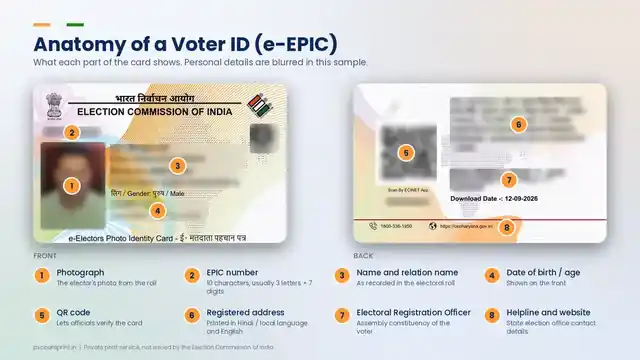
- EPIC number: a 10-character code, usually three letters followed by seven digits. This is the key to checking your name in the electoral roll, downloading your e-EPIC and tracking applications.
- Elector’s name and relation name: the name of your father, mother, husband or another relative as recorded in the roll.
- Gender and date of birth (or age): older cards may show only an age on a particular date.
- Photograph: the photo used in the electoral roll.
- Address: the registered residential address, usually on the back.
- Assembly constituency and part/serial number: these tell you which roll and which polling area you belong to.
- QR code: encodes elector details so an official can verify the card quickly. Do not paste a photo of your QR code on public sites.
Paper card, plastic card and e-EPIC: what is the difference?
Three versions are in circulation, and people often mix them up.
The older laminated or paper-based card was issued for many years and is still valid for those who hold it, though the print can fade and details may be hard to read.
The e-EPIC was launched by the ECI on National Voters’ Day, 25 January 2021. It is a secure PDF version of your card that you can download after logging in to the voter portal with your registered mobile number. You do not wait for a postal delivery. We have a step-by-step guide here: how to download your e-EPIC.
A PVC print of your e-EPIC or card is a private convenience copy on a durable wallet-size card. It is not issued by the ECI. We explain what that means in our guide to PVC voter cards.
What can you use a Voter ID for?
- Voting: proving your identity at the polling station. If you do not have the card on polling day, the ECI allows a list of alternative photo documents such as Aadhaar, passport, driving licence or PAN. Always check the current list on the ECI website before polling day.
- General identity proof for banking, mobile connections, travel and many government forms.
- Address proof in many situations, because the card carries your registered address. Whether an office accepts it is that office’s own decision.
It is not, on its own, a guarantee of citizenship or a substitute for a passport. Treat it as a strong identity document, not as an all-purpose legal certificate.
How to check that your details are correct
- Visit the official electoral search page of the ECI and search using your EPIC number or your name and details.
- Check the spelling of your name, your age or date of birth, your relation name and your address.
- If something is wrong, file a correction using Form 8. Our guide on voter ID forms 6, 6B, 7 and 8 shows which form to use.
Keep your voter ID safe
- Never share the OTP sent to your mobile number during login. Nobody from the election office will ask for it by call or message.
- Share a copy only when needed and note the purpose on it if the receiver permits.
- If you lose your card, you can download your e-EPIC again or apply for a replacement. See what to do if your voter ID is lost.
Want a durable wallet-size copy?
If you would like your e-EPIC or card photo on a sturdy card that does not tear or fade, you can order our Voter ID (EPIC) PVC card print. We print the file you supply exactly as it is, in CR80 size, and ship it by Speed Post.
Frequently asked questions
What is the full form of EPIC in voter ID?
Electors Photo Identity Card.
How many characters are in an EPIC number?
Typically ten: three letters followed by seven digits. Some older cards may show a different layout, so check the electoral roll if you are unsure.
Is the Voter ID card free?
Yes, the official card issued by the Election Commission is free. Charges you may see on private sites are for their own services such as printing or form help.
Can I vote without a Voter ID card?
If your name is in the electoral roll, you can vote by showing one of the alternative photo ID documents that the ECI approves. Check the list before polling day.
Reviewed October 2026. Rules and portals can change, so confirm important steps on the official Election Commission of India website. DM Incorporation is a private printing service and is not connected to the Election Commission of India.